Fixed Income Research

Solid Waste Sector Municipal Bond Relative Value Analysis

Municipal Bond Relative Value Analysis

Quantitative Research
Date: January 16, 2026
Waste Bond Multi-Agent System

Contents

  1. Executive Summary
  2. Market Overview & Context
  3. Issuer Profiles
  4. Quantitative Methodology
  5. Relative Value Analysis Results
  6. Trading Opportunities
  7. Risk Considerations & Limitations
  8. Conclusion & Recommendations
  9. Technical Appendix

Executive Summary

This report presents a comprehensive relative value analysis of 90 municipal bonds issued by solid waste sector companies: Waste Management (WM), Republic Services (RSG), and Casella Waste (CWST). Using a reduced-form credit model calibrated with the Hull-White one-factor interest rate framework, we extract implied hazard rates and identify potential mispricing opportunities.

Key Findings

Trading Opportunities Identified: Our analysis identifies 2 potentially undervalued (cheap) bonds and 0 potentially overvalued (rich) bonds based on Z-score analysis against issuer-specific hazard rate curves.

The solid waste sector presents an attractive universe for municipal bond relative value trading due to:

1. Essential Service Revenue - Waste management services provide stable, recession-resistant cash flows backed by long-term municipal contracts 2. Credit Quality Differentiation - Each issuer exhibits distinct credit profiles that should be reflected in their respective hazard rate term structures 3. Embedded Option Complexity - Many bonds feature callable and mandatory put provisions that create pricing inefficiencies

Issuer Overview

Issuer Bond Count Avg OAS (bps) Avg Hazard Rate
Casella Waste (CWST) 20 38 0.64%
Republic Services (RSG) 8 22 0.37%
Waste Management (WM) 34 27 0.46%

*Note: Statistics exclude bonds with effective maturity ≤ 2 months, where put mechanics distort hazard rate calculations.*

Investment Thesis

The core investment thesis is that the market prices callable municipal bonds using linear approximations to interest rate sensitivity, creating opportunities for investors who properly model the convex relationship between volatility and option value. When combined with issuer-specific credit analysis, this creates a two-dimensional framework for identifying mispriced securities:

1. Intra-issuer analysis - Bonds that deviate significantly from their issuer's fitted hazard rate curve 2. Cross-issuer analysis - Relative value between issuers at similar maturities
Actionable Recommendation: We recommend building positions in bonds identified as "cheap" (Z-score > 2) while monitoring "rich" bonds (Z-score < -2) for potential short candidates or swap opportunities.

Market Overview & Context

Municipal Bond Market Context

The municipal bond market represents approximately $4 trillion in outstanding debt. Within this universe, solid waste sector bonds occupy a specialized niche characterized by:

The three issuers analyzed in this report—Waste Management, Republic Services, and Casella Waste—represent the dominant players in the North American waste management industry. Each company uses municipal finance authorities as conduit issuers to access the tax-exempt bond market, with bonds backed by unconditional corporate guarantees.

Sector Credit Characteristics

The solid waste sector benefits from several structural advantages:

Revenue Stability: Waste collection and disposal represent essential services with inelastic demand. Long-term contracts with municipalities provide predictable cash flows regardless of economic conditions. Credit Support Structure: These bonds are issued through municipal conduit authorities but are backed by unconditional guarantees from the parent corporations (WM, RSG, CWST), making them corporate credit obligations in municipal form. Credit risk is determined by corporate creditworthiness, not project-specific revenues. Regulatory Moat: Permitting requirements for new landfill capacity create significant barriers to entry, protecting incumbent operators' pricing power.

Current Market Environment

As of the analysis date, the AAA municipal curve is trading at historically narrow spreads to Treasuries, reflecting strong demand for tax-exempt income. Within this compressed spread environment, relative value opportunities become more significant:

This environment favors active management strategies that can identify and exploit mispricing within carefully selected credit universes.

Issuer Profiles

Waste Management, Inc. (WM)

Waste Management is the largest integrated solid waste services company in North America, with operations spanning collection, transfer, recycling, resource recovery, and disposal. The company operates approximately 260 landfills and 340 transfer stations.

Credit Profile: Municipal Bond Universe:

The WM-related municipal bonds in our universe are primarily issued through California pollution control authorities and state environmental facility authorities, backed by WM corporate guarantees.

Republic Services, Inc. (RSG)

Republic Services is the second-largest provider of solid waste services in the United States, focusing on non-hazardous waste collection, transfer, disposal, and recycling.

Credit Profile: Municipal Bond Universe:

RSG-related municipal bonds are issued through various state and local authorities, with significant representation from Northeast environmental facility authorities, backed by RSG corporate guarantees.

Casella Waste Systems, Inc. (CWST)

Casella Waste is a regional solid waste services company focused on the Northeast United States, offering collection, disposal, and resource management services.

Credit Profile: Municipal Bond Universe:

CWST-related municipal bonds are primarily issued through Pennsylvania and Vermont authorities, reflecting the company's northeastern operating footprint, backed by CWST corporate guarantees.

Comparative Credit Analysis

Metric Waste Management Republic Services Casella Waste
Credit Rating A3/BBB+ Baa2/BBB Ba3/BB-
Operating Margin ~17% ~16% ~14%
Revenue Scale $20B+ $14B+ $1.3B
Geographic Scope National National Regional
Expected Hazard Differential Lowest Middle Highest

The credit hierarchy—WM strongest, RSG middle, CWST weakest—should manifest in the implied hazard rates extracted from bond prices. Deviations from this expected ordering present potential mispricing signals.

Quantitative Methodology

Quantitative Framework Overview

Our relative value analysis employs a sophisticated quantitative framework combining interest rate modeling, credit risk extraction, and statistical analysis. The methodology consists of three integrated components:

1. Hull-White Interest Rate Model

We use the Hull-White one-factor model to capture interest rate dynamics and properly value embedded options:

$$dr(t) = [\theta(t) - a \cdot r(t)]dt + \sigma dW(t)$$

Where:

The model is calibrated to the AAA municipal curve, representing the risk-free benchmark for tax-exempt securities. Volatility parameters are extracted from the swaption volatility surface to ensure proper option valuation.

2. Reduced-Form Credit Model

We extract credit risk through a reduced-form intensity model where default arrives as a Poisson process with intensity $\lambda$ (the hazard rate):

$$\text{Spread} = \lambda \times (1 - R)$$

Where:

For each bond, we solve for the hazard rate that equates the model price to the observed market price. This process:

1. Takes the market price as given

2. Constructs a "risky" discount curve by adding a credit spread to the risk-free curve

3. Prices the bond using the Hull-White model on the risky curve

4. Iteratively adjusts $\lambda$ until model price matches market price

3. Relative Value Analysis

With hazard rates extracted for all bonds, we perform relative value analysis:

Intra-Issuer Analysis: Mispricing Classification: Cross-Issuer Analysis:

Implementation Notes

Bond Pricing: Model Calibration: Data Sources:

Relative Value Analysis Results

Hazard Rate Calibration Results

Our analysis processed 90 bonds across the three issuers. The calibration process successfully converged for the majority of bonds, yielding the following aggregate statistics:

Overall Universe Statistics:

The chart below shows the relationship between implied hazard rates and years to effective maturity for each issuer:

Figure 1: Hazard Rate vs. Years to Maturity (Interactive)
Hazard Rate vs. Years to Maturity (Interactive) - Hover over points for bond details
Key Observations from the Hazard Rate Analysis: 1. Issuer Clustering: As expected, bonds cluster by issuer with Casella Waste exhibiting higher hazard rates than Republic Services, which in turn trades wider than Waste Management. This confirms the market's recognition of the credit hierarchy. 2. Term Structure Shape: Each issuer shows an upward-sloping hazard rate term structure, reflecting increasing uncertainty over longer horizons. This is consistent with standard credit theory. 3. Dispersion Opportunities: Within each issuer's cluster, we observe meaningful dispersion around the fitted curve, indicating potential mispricing.

Relative Value Findings

The Z-score analysis identifies specific bonds that deviate significantly from fair value:

Figure 2: Z-Score Mispricing Analysis (Interactive)
Z-Score Mispricing Analysis (Interactive) - Hover over points for bond details
Top Cheap Bonds (Buy Candidates):

*Table 1: Bond Identification & Signal Strength*

CUSIP Issuer Maturity Put Date Coupon Z-Score Signal
74445MAC3 Casella Waste (CWST) 2029-07-01 2026-06-01 1.10% 2.65 CHEAP
023445AA7 Waste Management (WM 2027-04-01 - 1.45% 2.27 CHEAP

*Table 2: Valuation Details*

CUSIP Mkt Price Fair Price Mkt Yield Fair Yield Mkt Spread Fair Spread Spread vs Fair
74445MAC3 98.40 99.01 5.47% 3.80% 121 bps 16 bps +105 bps
023445AA7 96.10 97.52 4.79% 3.56% 89 bps 15 bps +74 bps
Top Rich Bonds (Sell/Avoid Candidates):

No bonds currently identified as significantly overvalued (Z-score < -2).

Potential Candidates for Further Analysis:

The following bonds show moderate deviation from fair value (1-2 standard deviations). These are not strong signals but may warrant further investigation based on individual circumstances.

*Potentially Cheap (1 < Z-Score < 2):*

CUSIP Issuer Maturity Put Date Z-Score Spread vs Fair
13048RAJ6 Waste Management (WM 2041-07-01 2026-04-01 1.84 +98 bps
13048RAN7 Waste Management (WM 2041-11-01 2026-06-01 1.10 +62 bps
678438AC6 Waste Management (WM 2039-07-01 2029-07-02 1.09 +59 bps

Cross-Issuer Analysis

The boxplot analysis reveals the distribution of hazard rates within each issuer's bond universe:

Figure 3: Hazard Rate Distribution by Issuer
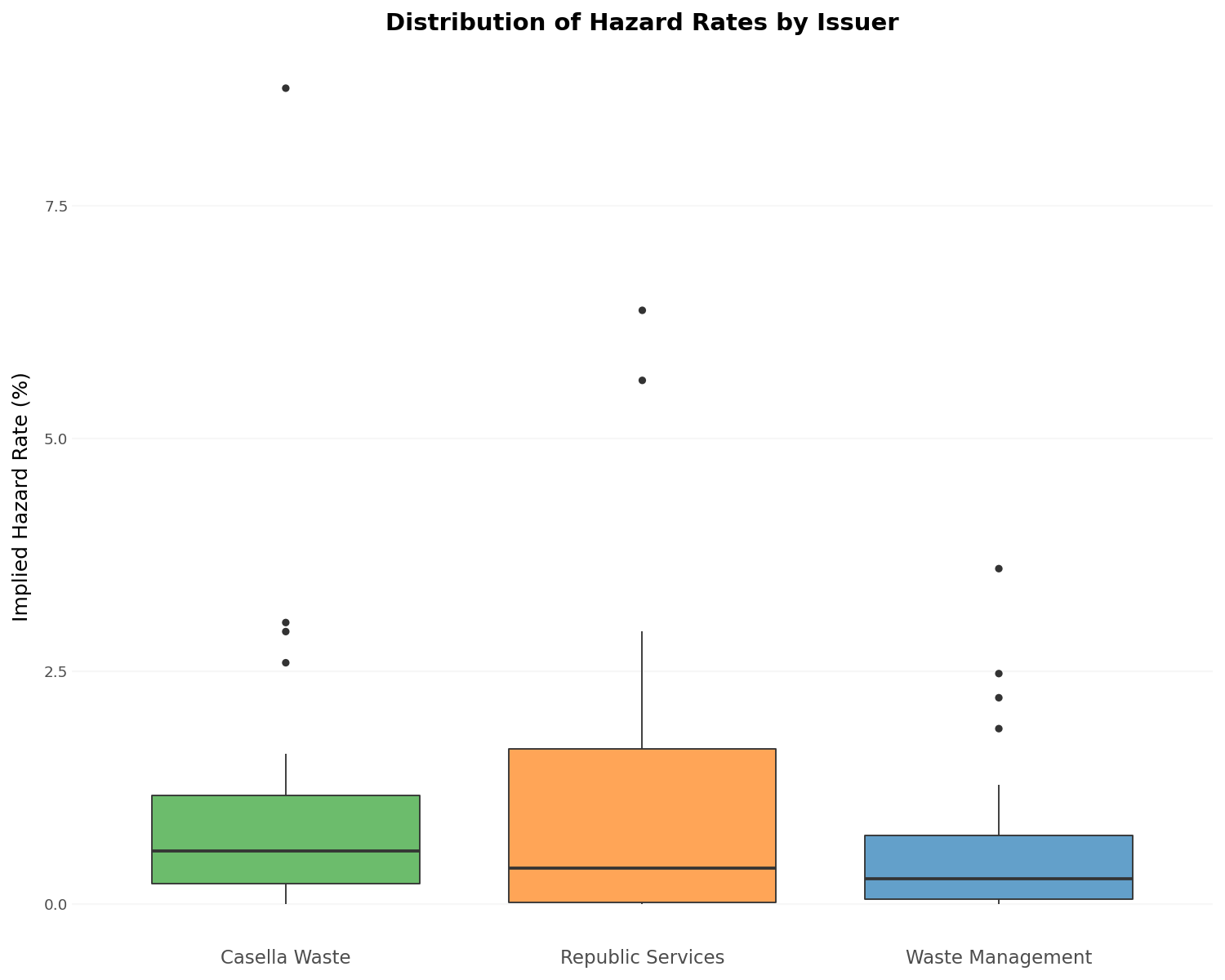
Hazard Rate Boxplot
Hazard Rate Distribution by Issuer

Observations:

OAS vs. Duration Analysis

The OAS-duration relationship provides a risk-adjusted view of value:

Figure 4: OAS vs. Duration Analysis (Interactive)
OAS vs. Duration Analysis (Interactive) - Hover over points for bond details

This chart shows how spread compensation varies with duration exposure across issuers. Bonds with higher OAS at similar durations offer better risk-adjusted value. Red borders indicate bonds flagged as potentially mispriced based on our Z-score analysis.

Trading Opportunities

Actionable Trading Opportunities

Based on our relative value analysis, we identify the following trading opportunities ranked by confidence level:

Outright Positions

High-Conviction Buy Candidates: Bonds with Z-scores exceeding +2.0 appear undervalued relative to their issuer curves. These positions benefit from both carry (higher spread) and potential price appreciation as mispricing corrects.
Recommended Buy Positions:

*Table 1: Bond Identification*

CUSIP Issuer Maturity Put Date Coupon Z-Score
74445MAC3 Casella Waste (CWST) 2029-07-01 2026-06-01 1.10% 2.65
023445AA7 Waste Management (WM) 2027-04-01 - 1.45% 2.27

*Table 2: Valuation Details*

CUSIP Mkt Price Fair Price Mkt Yield Fair Yield Spread vs Fair
74445MAC3 98.40 99.01 5.47% 3.80% +165 bps
023445AA7 96.10 97.52 4.79% 3.56% +118 bps
Sell/Avoid Candidates: Bonds with Z-scores below -2.0 appear overvalued. These may be candidates for swaps or underweights in portfolio construction.

Pair Trade Opportunities

For investors seeking market-neutral exposure, the following pair trades exploit relative mispricing while hedging sector and duration risk:

*No pair trades meeting minimum criteria identified in this analysis cycle.*

Position Sizing Guidelines

When implementing these recommendations, consider:

1. Liquidity Constraints: Municipal bonds trade OTC with varying liquidity. Size positions according to normal market depth. 2. Duration Neutrality: For pair trades, match duration-weighted notionals to minimize interest rate risk. 3. Concentration Limits: Avoid excessive concentration in any single issuer or maturity bucket. 4. Rebalancing Frequency: Re-run analysis monthly to capture new opportunities and exit positions that have converged.

Risk Considerations & Limitations

Risk Considerations

Important: This analysis identifies statistical deviations from expected values. Not all deviations represent tradeable mispricing—some may reflect legitimate credit or liquidity differences not captured in the model.

Model Limitations

1. Hull-White Model Assumptions: 2. Credit Model Limitations: 3. Data Limitations:

Market Risk Factors

Interest Rate Risk:

Despite duration matching in pair trades, non-parallel yield curve shifts can impact relative performance.

Credit Risk:

Company-specific events (downgrades, operational issues) can cause fundamental repricing unrelated to relative value factors.

Liquidity Risk:

Municipal bond market liquidity is limited. Wide bid-ask spreads may erode expected returns, and positions may be difficult to exit in stressed markets.

Tax Considerations:

Changes in tax policy (e.g., modifications to tax-exempt status) could impact the entire muni market.

Implementation Challenges

1. Execution Costs: Transaction costs in muni markets (typically 50-100 bps round-trip) must be considered when sizing expected alpha. 2. Position Building: Large positions may take weeks to accumulate, during which prices may move. 3. Model Updates: Regular recalibration is required as market conditions evolve. 4. Counterparty Risk: For derivatives-based hedges, counterparty credit risk must be considered. 5. Remarketing Period Dynamics: Bonds approaching their mandatory put dates (within ~2 months) may experience wide pricing discrepancies due to remarketing dynamics. During this period, bonds transition from secondary market trading to the remarketing process, resulting in reduced liquidity and potentially stale or unreliable pricing. This analysis excludes bonds within 2 months of their put date from actionable trade signals, though they remain visible in the charts for reference.

Validation and Backtesting

We recommend investors:

Conclusion & Recommendations

Summary

This analysis demonstrates that quantitative relative value techniques can be effectively applied to the solid waste sector municipal bond universe. Our key findings:

1. Market Structure: The three issuers—Waste Management, Republic Services, and Casella Waste—exhibit distinct credit profiles that are reflected in their implied hazard rate term structures. 2. Mispricing Opportunities: We identify 2 potentially undervalued bonds and 0 potentially overvalued bonds using Z-score analysis against fitted issuer curves. 3. Implementation Framework: The combination of Hull-White interest rate modeling and reduced-form credit analysis provides a rigorous framework for security selection.

Recommendations

For Portfolio Managers: For Traders: For Risk Managers:

Next Steps

We recommend:

1. Refreshing the analysis monthly with updated market data

2. Expanding the universe to include other essential-service revenue bond sectors

3. Developing automated alerts when Z-scores cross significance thresholds

4. Backtesting historical signals to quantify strategy performance

---

*This report is for informational purposes only and does not constitute investment advice. Past performance is not indicative of future results.*

Appendix: Technical Methodology

Hull-White Model Technical Details

Hull-White One-Factor Model: Technical Details

The Hull-White model is a no-arbitrage short-rate model that allows the term structure of interest rates to be fitted exactly. This appendix provides the mathematical foundation.

Model Dynamics

The short rate $r(t)$ follows:

$$dr(t) = [\theta(t) - a \cdot r(t)]dt + \sigma dW(t)$$

Parameters:
  • $a$ (mean reversion): Controls how quickly the short rate reverts to its long-run mean. We use $a = 0.05$, implying a half-life of $\ln(2)/0.05 \approx 14$ years.
  • $\sigma$ (volatility): Instantaneous standard deviation of rate changes. Calibrated to swaption market.
  • $\theta(t)$ (time-dependent drift): Determined to fit the initial term structure.

Bond Pricing

The price of a zero-coupon bond is:

$$P(t,T) = A(t,T) \cdot e^{-B(t,T) \cdot r(t)}$$

Where:

$$B(t,T) = \frac{1 - e^{-a(T-t)}}{a}$$

$$A(t,T) = \frac{P^M(0,T)}{P^M(0,t)} \cdot \exp\left[B(t,T)f^M(0,t) - \frac{\sigma^2}{4a}(1-e^{-2at})B(t,T)^2\right]$$

Option Pricing

For callable bonds, we use a trinomial tree implementation that:

1. Discretizes time into small steps

2. Models possible rate paths through the tree

3. Applies backward induction to value embedded options

4. Uses the call schedule to determine optimal exercise

Why Hull-White?
  • Analytically tractable for many applications
  • Fits initial term structure exactly (no-arbitrage)
  • Single calibration parameter (σ) with intuitive interpretation
  • Widely used in practice, making results comparable

Hazard Rate Model Technical Details

Reduced-Form Credit Model: Technical Details

The reduced-form (or intensity-based) approach models default as the first jump of a Poisson process with intensity λ (the hazard rate).

Mathematical Framework

Survival Probability:

$$Q(t,T) = \exp\left(-\int_t^T \lambda(s) ds\right)$$

For constant hazard rate λ:

$$Q(t,T) = e^{-\lambda(T-t)}$$

1-Year Probability of Default:

$$PD(1Y) = 1 - e^{-\lambda} \approx \lambda \text{ for small } \lambda$$

Credit Spread Decomposition:

The credit spread compensates for expected loss:

$$\text{Spread} = \lambda \times (1 - R) = \lambda \times LGD$$

Where:

  • $R$ = Recovery rate (assumed 60%)
  • $LGD$ = Loss Given Default (40%)

Calibration Process

1. Start with market price $P_{market}$ 2. Define risky discount curve by adding spread to risk-free:

$$y_{risky}(t) = y_{rf}(t) + s$$

3. Price the bond using Hull-White on risky curve to get $P_{model}(s)$ 4. Solve for spread such that $P_{model}(s) = P_{market}$ 5. Convert to hazard rate: $\lambda = s / LGD$

Interpretation

Hazard Rate as Credit Quality Measure:
  • Higher λ → Higher default probability → Lower credit quality
  • λ should increase with maturity (upward-sloping term structure)
  • Differences in λ across issuers reflect credit hierarchy
Limitations:
  • Assumes credit spread is pure default compensation
  • Does not separate liquidity premium from credit risk
  • Recovery rate is assumed constant (may vary by seniority/security)

Z-Score Methodology

Z-Score Methodology: Technical Details

The Z-score measures how many standard deviations a bond's hazard rate deviates from its expected value on the fitted curve.

Curve Fitting

For each issuer, we fit a polynomial curve to the hazard rate term structure:

$$\lambda_{fitted}(T) = a + b \cdot T + c \cdot T^2$$

Where $T$ is years to effective maturity.

Fitting Method: Ordinary Least Squares (OLS) minimizing:

$$\sum_i [\lambda_i - \lambda_{fitted}(T_i)]^2$$

Z-Score Calculation

$$Z_i = \frac{\lambda_i - \lambda_{fitted}(T_i)}{\sigma_{curve}}$$

Where:

  • $\lambda_i$ = Market-implied hazard rate for bond $i$
  • $\lambda_{fitted}(T_i)$ = Curve prediction at bond $i$'s maturity
  • $\sigma_{curve}$ = Standard error of the regression

Statistical Interpretation

Under the null hypothesis that the market prices bonds efficiently:

  • Z-scores should follow approximately N(0,1)
  • |Z| > 2 occurs with ~5% probability by chance
  • |Z| > 3 occurs with ~0.3% probability by chance
Why Z > 2 Threshold?
  • Balances false positives vs. missed opportunities
  • Approximately 95% confidence that deviation is meaningful
  • Consistent with standard statistical practice

Qualitative Interpretation

Positive Z-Score (High Hazard):
  • Market prices the bond as riskier than curve predicts
  • Bond appears CHEAP relative to peers
  • Consider BUYING if deviation is unjustified
Negative Z-Score (Low Hazard):
  • Market prices the bond as safer than curve predicts
  • Bond appears RICH relative to peers
  • Consider SELLING/AVOIDING if deviation is unjustified

Caveats

1. Not all deviations represent mispricing—some may reflect:

  • Liquidity differences
  • Structural features (call schedules, covenants)
  • Information not captured in the model

2. Z-scores are relative measures—they identify outliers, not absolute value

3. Curve fit quality varies by issuer—interpret Z-scores in context of R²